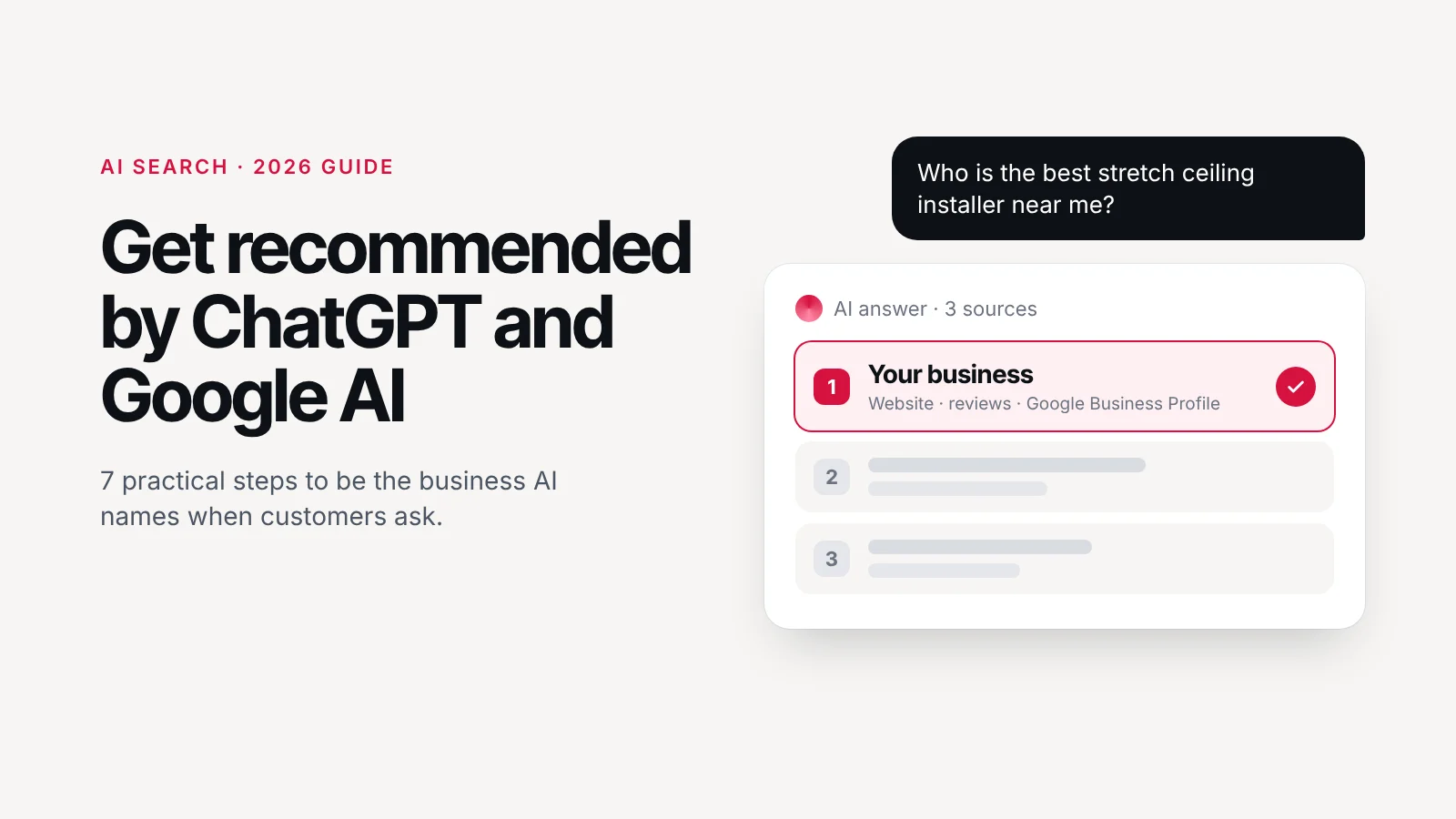
More and more customers no longer scroll through ten blue links. They ask ChatGPT, Gemini or Google’s AI Mode something like “who installs stretch ceilings in Vâlcea?” or “a good web agency for a small business” and get an answer that names three or four companies. If your business is one of them, you get the call. If not, the customer may never see your website at all.
This guide explains, in plain words, how to get recommended by ChatGPT and Google AI: how these tools choose the businesses they mention, the seven steps that actually make a difference, what you can safely ignore, and a real example from our own work.
How do ChatGPT and Google AI choose which businesses to recommend?
When a question needs fresh or local information, AI assistants search the web in real time. They read several pages, compare what they find and write an answer, usually with links to their sources. They do not pick businesses at random, and they do not have a secret list. They recommend what they can find, read and trust.
- ChatGPT uses its own crawler, OAI-SearchBot, to find pages for its search answers. OpenAI says sites that block this crawler will not appear in ChatGPT’s search answers. (OpenAI crawler documentation)
- Google AI Overviews and AI Mode use pages from Google’s normal index. Google runs several related searches for one question (it calls this “query fan-out”) and links to the pages it used. (Google Search Central)
- Microsoft Copilot and Bing’s AI summaries rely on the Bing index.
So the question is not only “does my website rank?”, but also “can the AI read it, does it clearly understand what I do and where, and do other sources confirm it?”. That is what the steps below are about.
7 steps to get recommended by ChatGPT and Google AI
1. Let AI crawlers read your website
This is the step most businesses miss, and nothing else works without it. Check three things:
- robots.txt does not block OAI-SearchBot (ChatGPT search), Googlebot or Bingbot. You can block GPTBot, which is used for training AI models, and still appear in ChatGPT search, because the two settings are independent.
- Your hosting, CDN or firewall does not block AI bots. Some services, Cloudflare among them, started blocking AI crawlers by default, so a site can be invisible to AI without the owner knowing.
- Google can index your pages and show a snippet. Google says this is the only technical requirement to appear in AI Overviews and AI Mode.
Also keep the important information as real text on the page. A price list or a list of services inside an image is easy for people to see, but much harder for an AI to use.
2. Say clearly what you do, where and for whom
AI assistants answer specific questions: a service, in a town, for a type of customer. Your website should answer the same way.
- Give every main service its own page, with a clear title such as “Stretch ceilings in Râmnicu Vâlcea”, not just “Services”.
- If you work in several towns, say so on a dedicated page, and name each town.
- Write down the facts people and AI look for: what is included, typical prices or price ranges, how long the work takes, the steps of working with you, guarantees.
- Use the same company name, address and phone number everywhere: website, Google Business Profile, Facebook, directories.
Vague marketing text (“we offer quality solutions”) gives an AI nothing to quote. Concrete sentences do.
3. Answer the questions customers ask
The questions people type into ChatGPT are the same ones they ask you on the phone: how much does it cost, how long does it take, does it work in a bathroom, what is the difference between two options. Answer them on your website, on service pages, in a FAQ section and in blog articles.
Google’s 2026 guide on generative AI search points in the same direction: it favours original content with real insight over generic text that could be on any site. Your own prices, your own projects, photos of your work and the problems you solved for clients are exactly that kind of content.
4. Keep your Google Business Profile complete and collect reviews
For local searches, the Google Business Profile is one of the strongest signals. Google’s own AI guide lists keeping Business Profile information current as a best practice. Make sure it has:
- the right category, address, phone number, website and opening hours;
- real photos of your work, added regularly;
- a short description that names your main services and the area you cover;
- reviews from real customers, with replies from you.
Ask happy customers for a review right after the job is done. Never buy reviews: it breaks Google’s rules and can get the profile suspended.
5. Be mentioned on other trusted websites
AI assistants check whether other sources confirm what your website says. Useful mentions come from local and industry directories, your suppliers or partners, local news sites, associations and genuine customer reviews on other platforms.
Focus on real mentions. Google says that chasing inauthentic mentions “isn’t as helpful as it might seem”, and paid link schemes can hurt you in normal search as well.
6. Don’t forget Bing
Many businesses only check Google. Add your site to Bing Webmaster Tools and submit your sitemap. Since February 2026 it also has an AI Performance report that shows how often Microsoft Copilot and Bing’s AI summaries cite your pages, and for which questions. It is one of the few tools that gives you real data on AI citations.
7. Check regularly what AI says about you
Once a month, ask ChatGPT, Gemini, Perplexity and Google’s AI Mode the questions your customers would ask: “best [service] in [town]”, “how much does [service] cost in [town]”, “who can I call for [problem]”. Note which businesses appear, which sources are linked and what is said about you. Answers change from one person and one day to another, so look at the trend, not a single answer.
What you don’t need
A lot of advice about AI search is noise. According to Google’s own documentation, to appear in AI Overviews and AI Mode you do not need:
- an llms.txt file or other special “AI files”;
- special schema markup (structured data is still useful for rich results in normal search);
- to split your texts into small chunks or write separate pages for every variation of a keyword.
Google puts it simply: there are “no additional requirements” beyond normal search. In other words, good SEO is still the base. What changes is that clarity, facts and other sources confirming you matter even more.
A real example: Iro Panoramic in Vâlcea
Iro Panoramic installs stretch ceilings in Râmnicu Vâlcea and the surrounding region. We rebuilt their WordPress website in 2026 and look after their SEO, blog and Google Business Profile. The work followed the same steps as above:
- a page for each service and finish, and a page listing every town they work in;
- blog articles that answer what customers ask before buying: prices, installation, whether a stretch ceiling works in a bathroom or kitchen;
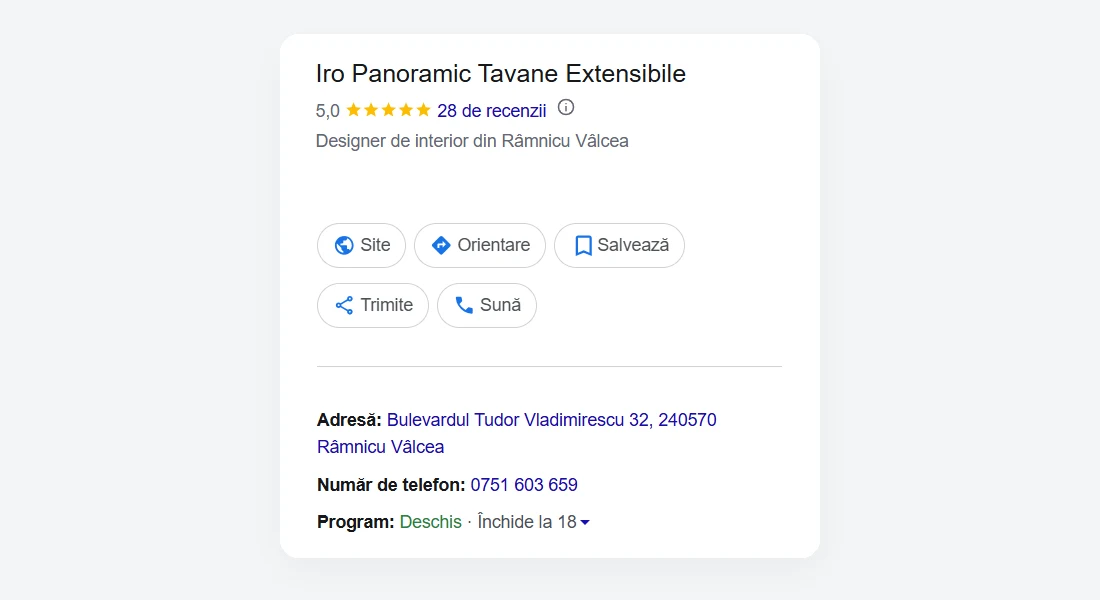
- a complete Google Business Profile with photos of real jobs and reviews from customers (5.0 from 28 reviews in November 2026).
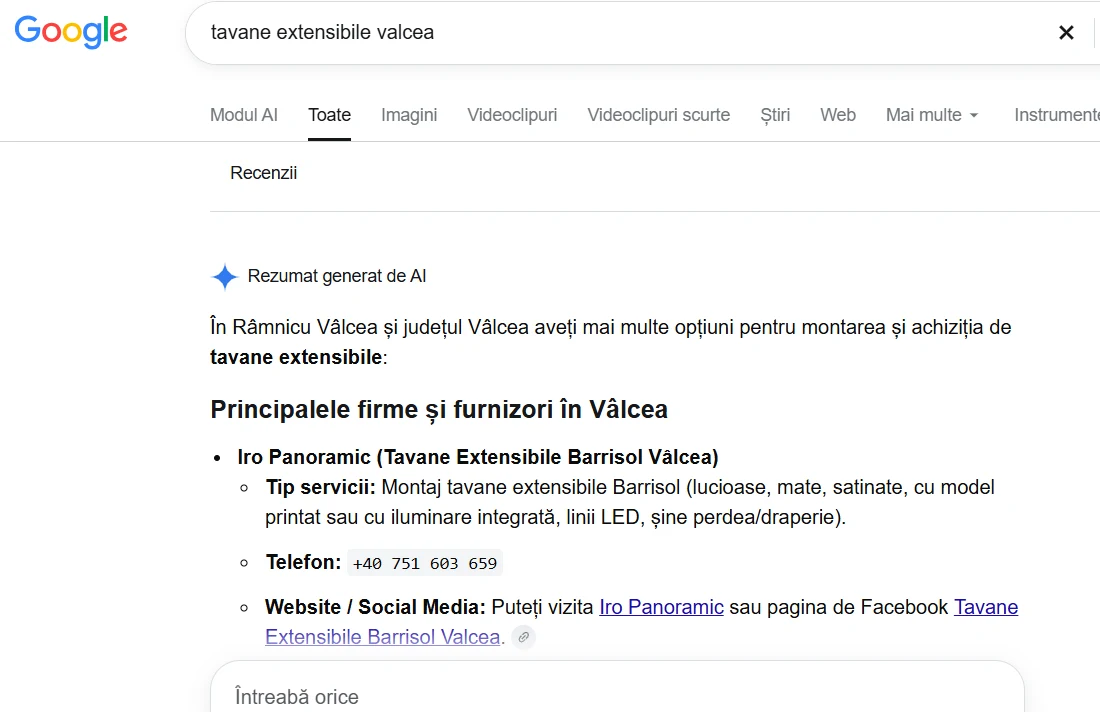
In November 2026, in Google’s AI summary for “tavane extensibile valcea” (stretch ceilings Vâlcea), Iro Panoramic is listed first among the stretch ceiling companies in the area, with its phone number, website and Facebook page.
The full story, with search results and speed scores, is in the Iro Panoramic case study.
How long does it take?
There is no fixed answer and nobody can honestly guarantee a place in an AI answer. Technical fixes, such as unblocking a crawler, can count within days. Clear service pages and a good Google Business Profile usually show results in a few weeks to a few months, once the pages are indexed. Reviews and mentions on other sites build up over time. The good news is that every step also helps your normal Google rankings, so the work is never wasted.
Frequently asked questions
Can I pay to get recommended by ChatGPT?
No. ChatGPT has started showing ads to some users, but they are shown separately and labelled. OpenAI says that “ads do not influence the answers ChatGPT gives you”, so the businesses named in the answer itself cannot buy their place.
Is AI search optimization different from SEO?
It builds on SEO. The basics are the same: a site that can be crawled, clear pages, useful content and trust. AI search adds more weight to clear facts, local information and confirmation from other sources. You will also see it called GEO (generative engine optimization) or AEO (answer engine optimization).
Does ChatGPT use Google results?
Not directly. ChatGPT search has its own crawler and works with third-party search providers. That is why a site can rank well on Google and still be missing from ChatGPT, for example when OAI-SearchBot is blocked. To get recommended by ChatGPT, check both: your Google rankings and whether ChatGPT can reach your site.
Do I need an llms.txt file?
No. Google says you don’t need it for AI Overviews or AI Mode. It does no harm, but on its own it will not get you recommended by ChatGPT or Google.
Want to know what AI says about your business?
We check how ChatGPT, Gemini and Google AI answer the questions your customers ask, find what is missing and fix it on your website, your Google Business Profile and beyond. Read more about our AI search visibility service and our SEO services, or ask for a quote.